
Should my kid be playing this?
Your child asks for a game. Maybe a friend has it, maybe they saw it online, maybe it's just the one everyone at school is talking about. You want to say yes - but you also have no real idea what's inside it. The box has an age number on it, sure, but a number doesn't tell you whether the "violence" is cartoon slapstick or lingering gore, whether "in-game purchases" means a cosmetic hat or a loot box built like a slot machine, or whether the online chat is the part you should actually be worried about. And you're not about to sink three hours into playing it yourself just to find out.
That gap - between a vague age sticker and the specific things a parent actually wants to know - is the problem. Official ratings exist, and they're useful as a first signal, but they flatten everything into a single label. A parent doesn't want a label. They want the concrete list: what's the violence like, is there gambling-style mechanics, strong language, scary imagery, real-money spending, strangers in voice chat. The stuff that decides whether a game is fine for an eight-year-old, fine only for a teenager, or fine for nobody in the house. That's what this feature is built to answer.
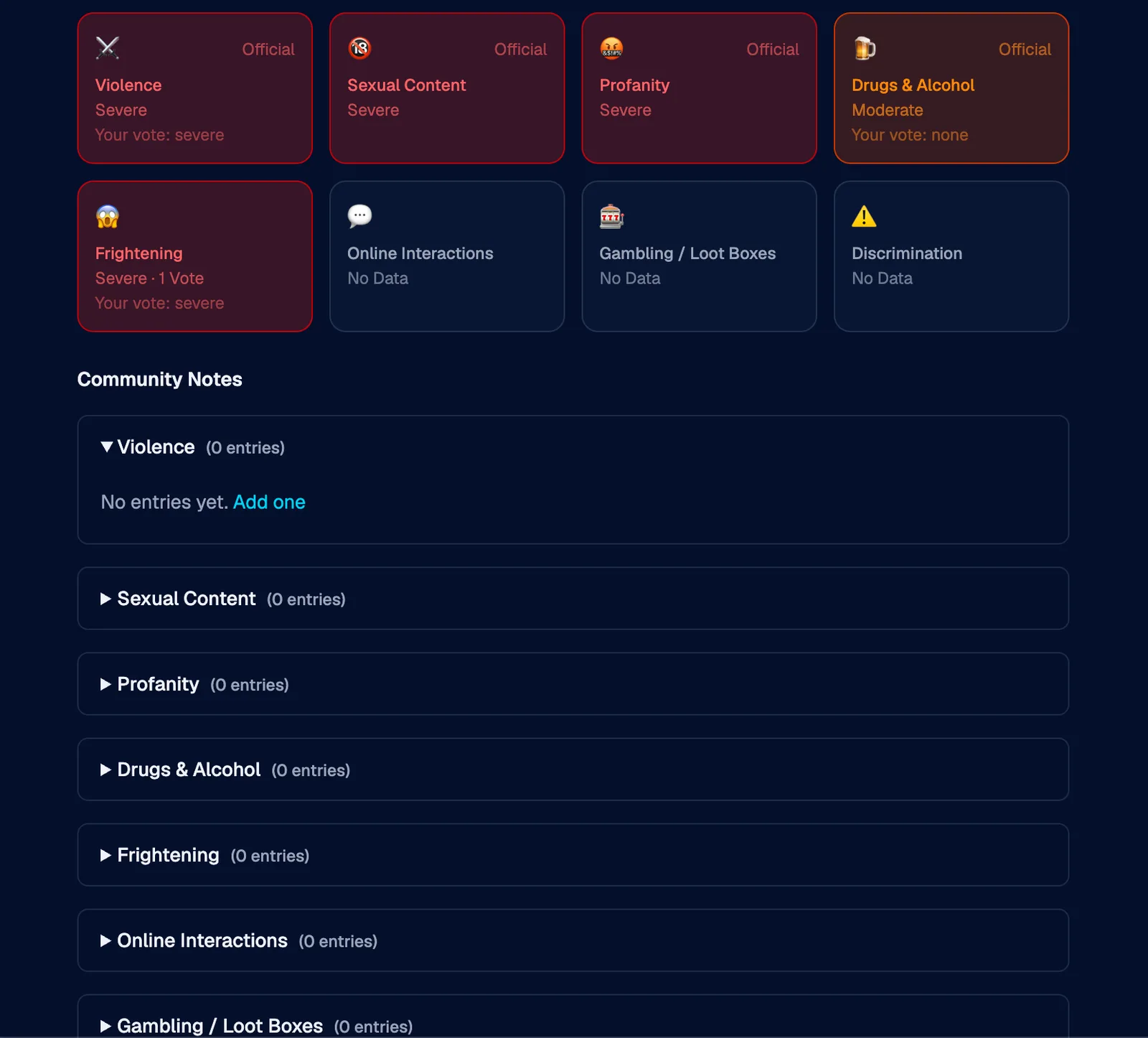
The parent guide tab has been sitting on game pages for a while now, and it never quite worked. The idea was always right - a parent should be able to land on a game page and get a real answer to "is this okay for my kid tonight" - but the page itself couldn't back that up. Eight collapsed sections, one per category - violence, language, gambling, and so on - and on almost every game, every single one said "No entries yet." Worse, the recommended age at the top of the page was configured to just hide itself unless enough categories already had confident data. Which, on a site this young with barely any votes logged yet, meant it was invisible almost everywhere. The feature that existed to answer a question was quietly refusing to answer it.
That's the honest situation a new site is in. We don't have years of community votes to lean on yet, and waiting around for thousands of parents to manually fill in eight categories per game before the page becomes useful isn't a real plan - it's just an empty page with extra steps. So instead of treating "no community data yet" as a dead end, I built a pipeline to give every page a reasonable starting point, clearly labeled as such, that the community can correct and build on top of as real votes come in.
The pipeline
Every game with any rating signal now gets run through Claude as part of a batch job. It reads the game's own data - genre, themes, story summary, whatever severity signals already existed - and writes back something concrete for each category: a plain verdict sentence, a suggested age, and specific examples where they're warranted. Not "this game contains violence," which tells a parent nothing they couldn't guess from the box art, but something like "decapitations and dismemberment during combat, blood pools persist." A sentence you can actually act on.
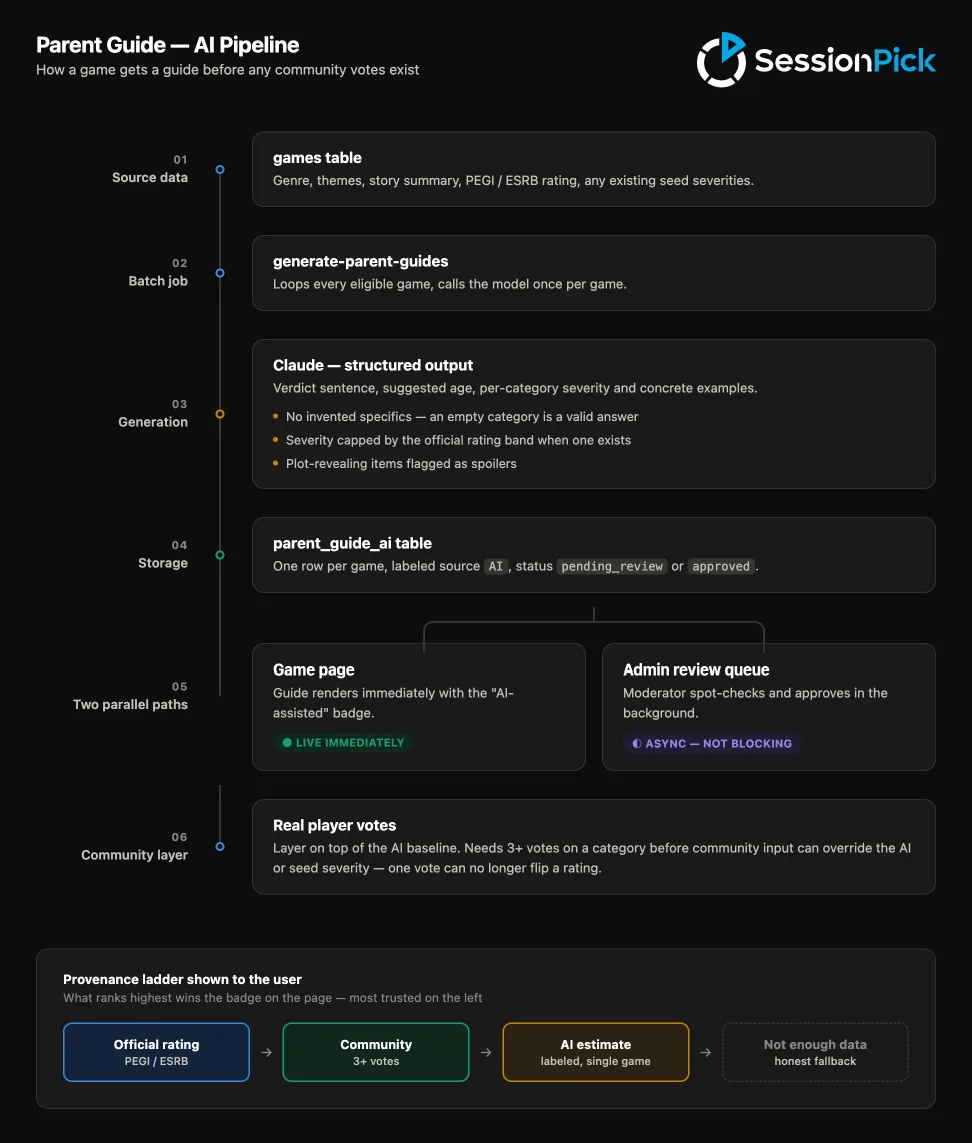
The prompt is deliberately strict about not inventing things. If the model can't tell whether something specific happens in a given game, it leaves that category empty rather than guessing - an empty category is a valid, honest output. Severity also has to stay consistent with the official age rating where one exists, so a PEGI 3 game can't come back with "severe" anything just because the model got creative. I spot-checked this against games I know well - Stardew Valley, Minecraft, The Witcher 3 - before trusting it at scale, and it holds the line well.
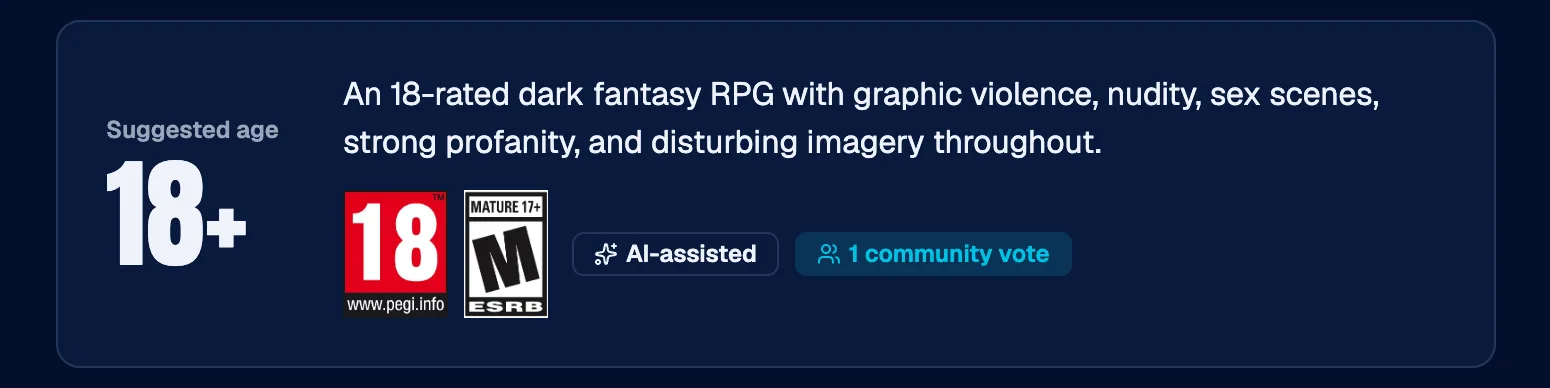
Every AI-written guide is labeled exactly as what it is. It's not passed off as verified fact - it sits behind an "AI-assisted" chip, clearly distinct from an official PEGI/ESRB rating badge and clearly distinct from a guide built up from real community votes. Right now there just over 4,000 games with an AI-generated guide live on the site. I review the queue on my end, but I made the call to have new guides go live immediately as AI-assisted rather than sit in a private moderation queue until I get around to them - a labeled estimate today is more useful to someone deciding what to play tonight than a perfect answer that shows up in three weeks.
What it looks like now
The top of the page always shows something now. A big, honest suggested age, a plain verdict sentence, and chips telling you exactly where that number came from - official rating first if one exists, then AI estimate, then community consensus once there's enough of it. If genuinely nothing exists yet for a game, you get an honest "not enough data yet" with an invite to be the first to add something, instead of a wall of silence.
Each category below that is a single row now instead of a dead accordion - icon, label, and a severity meter that fills in to show mild, moderate, or severe at a glance. Categories with real content float to the top; categories with nothing collapse into one quiet line at the bottom instead of pretending to be eight equally important empty boxes. Tap a row and it opens into specifics, spoiler-blurred where it should be, plus a real vote breakdown once enough people have weighed in on that category.
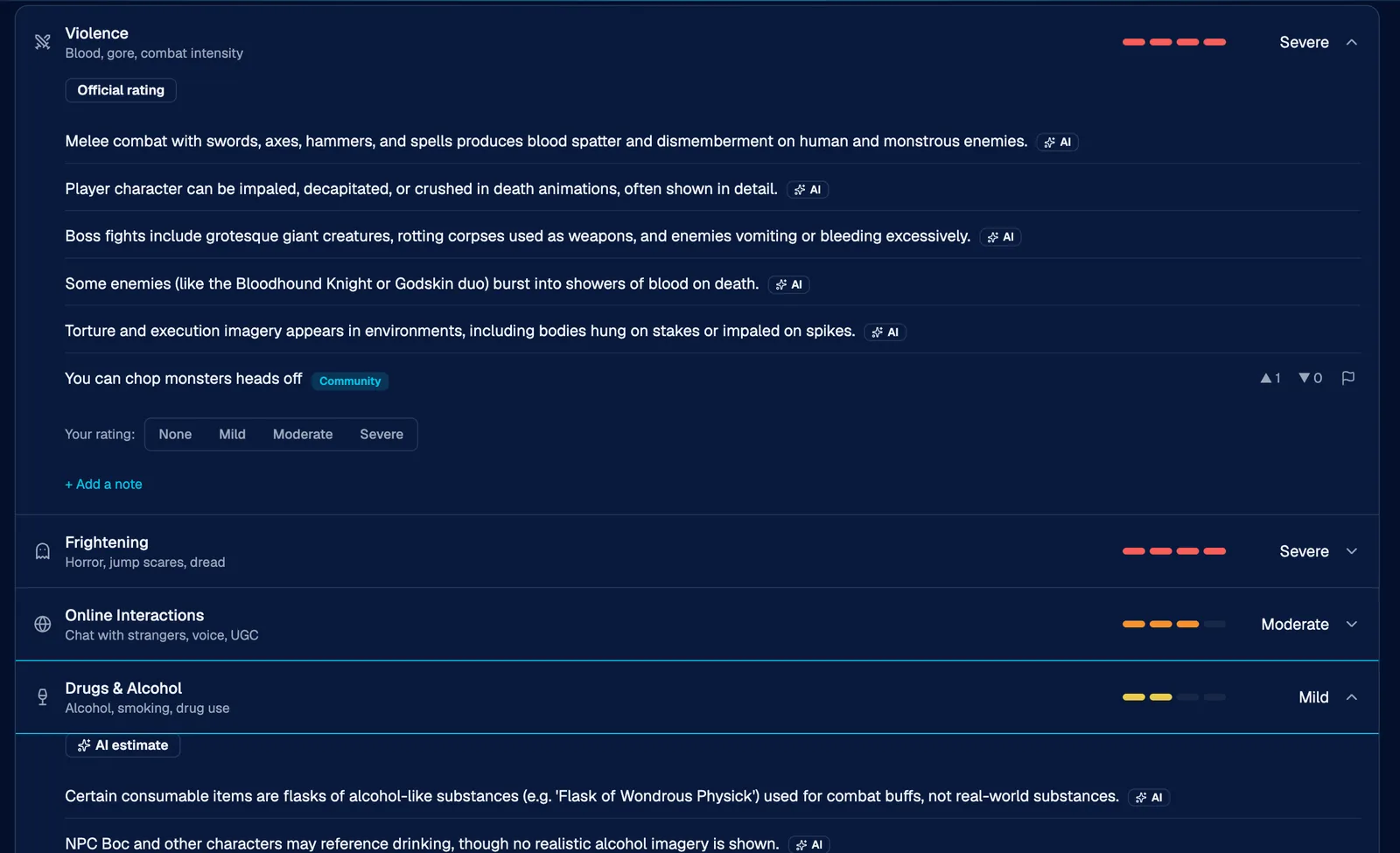
I also tightened up how community votes and AI estimates interact, since this is exactly the kind of place where the two need to hand off cleanly. A single vote can no longer flip an entire seeded rating on its own - it takes a few real votes before community input is trusted to override the starting estimate. The AI guide is meant to be a floor, not something one click should be able to knock over.
That's the model going forward for a site this early: start with something honest and clearly labeled, let real players correct and deepen it over time, and never leave a page blank just because the community hasn't caught up yet. If you want to see it in action, any game page has the tab - The Witcher 3 on sessionpick.com.
More from Development

The Steam scanner that tells you the truth about your library
What if you didn't have to sign up for anything to find out whether your own game library respects your time?
Your profile page just got a serious upgrade
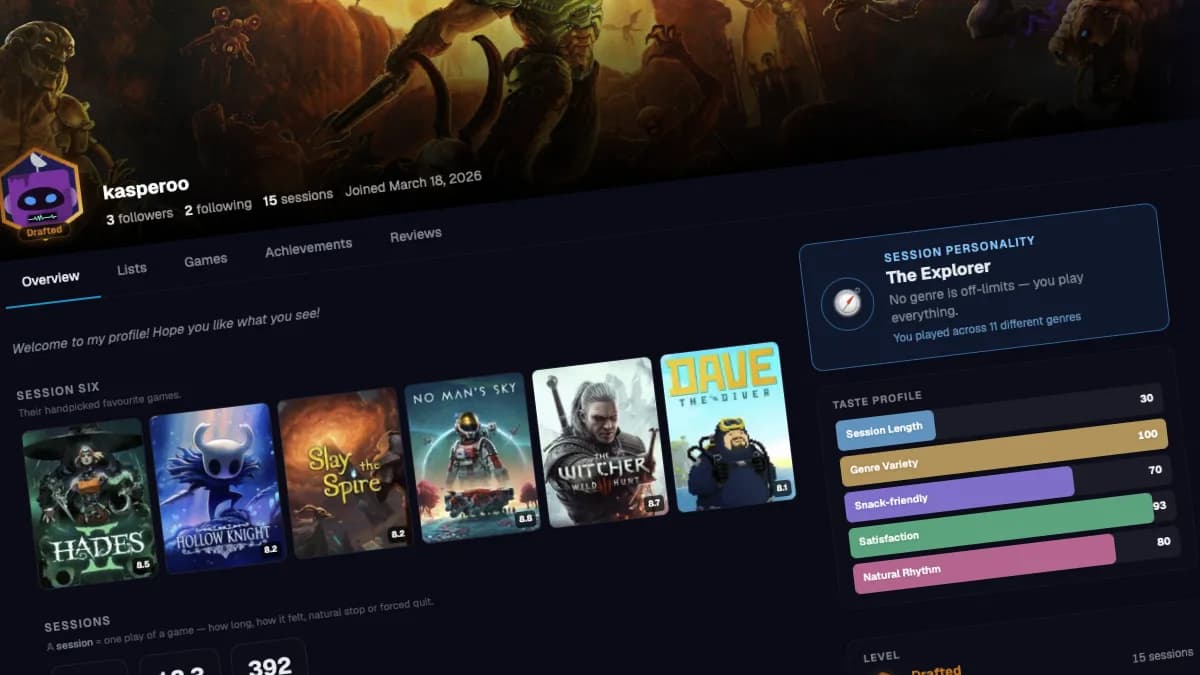
SessionPick profiles got a full redesign - hero banners, level frames, session personality, taste charts, and a feed worth reading. See what's new.

Find a game's soundtrack and art books without leaving the page
Browse any game on SessionPick and find its official soundtrack and art books alongside session scores, tips, and your personal game library.